By Jessica Arndt
When I saw the live update flash across my phone while watching YouTube that Charlie Kirk had been assassinated, my heart stopped. I didn’t want to believe it was true. For a fleeting second, I told myself it had to be a mistake, a rumor that would be corrected if I just waited. But it wasn’t. The truth landed hard: a man had been shot dead while speaking to college students. And before the shock even had a chance to settle, the celebrations began. Scrolling through my feed, I didn’t just see grief. I saw people I grew up with–neighbors, classmates, people I once thought of as decent–posting “he had it coming” or clicking laughing emojis beneath news articles. These weren’t faceless trolls in some distant corner of the internet. They were familiar faces. People who, in ordinary life, would offer kindness or help in a moment of need, now celebrating murder because the victim wore the wrong political jersey. That moment left me hollow, as if something vital in our shared humanity had been carved away. For posting nothing more than “RIP Charlie” and offering prayers for his family on my Instagram story, I was met with hate messages and lost a couple hundred followers overnight. Not because I endorsed his politics. Not because I defended every word he had ever said. But simply because I showed human compassion in the face of death. That exposed the rot of our age: a culture where even the simplest gesture of decency is condemned as betrayal.
Now, let me be clear: this isn’t going to be another article that simply bashes “the left” for its response. That would be too easy, and honestly, it would miss the point. If you’re willing to stay with me, I want to dig deeper–beyond the partisan blame game–because what we’re facing here isn’t just a political problem. It’s a moral one. It isn’t about left versus right. It’s about light versus darkness, and how easily ordinary people can be pulled into celebrating the unthinkable. Because let me be clear: celebrating murder is not politics. It is moral corruption. And once you frame it that way, the patterns become visible. Those who cheered Kirk’s death weren’t fighting for justice; they were swept up in narratives that had stripped him of his humanity. They didn’t believe they were celebrating a killing. They believed they were witnessing evil erased from the world.
And I’ll admit something here: if the headline had been about a child predator being killed, I doubt I’d feel much empathy. I wouldn’t celebrate, but I wouldn’t mourn either. That’s human nature when faced with someone who truly embodies harm. But that’s exactly the danger. Out-of-context clips and caricatures painted Charlie Kirk as if he were that level of monster—fascist, racist, irredeemably evil. Once someone has been framed in that light, empathy disappears. That’s the essence of dehumanization: it dissolves the human face, leaving only a caricature so monstrous that compassion no longer seems warranted.
I know this process because I once lived in it. Coming from the left, I hated Charlie Kirk. I thought he was a fascist, a racist, a monster–because that’s what the headlines said, and the viral clips confirmed it. But when I forced myself to actually watch the full speeches, I realized how much I had been lied to. Quotes that were supposed to prove his hatred often revealed the opposite in context. Words had been sliced apart, inverted, repackaged to build a caricature that bore little resemblance to reality. My hatred wasn’t rooted in truth–it was programmed. And if I could be manipulated into despising someone I hadn’t really listened to, so could anyone else, and it’s important to remind myself of this. That’s why this assassination is not just another tragedy. It is a mirror. It shows us what happens when debate dies and violence takes its place. History is merciless on this point: when ideas can survive only through censorship, intimidation, or bullets, they are already bankrupt. Assassinations are never about silencing the irrelevant. They are about silencing the effective. Martin Luther King Jr. was not killed because his vision was weak–he was killed because it was spreading. John F. Kennedy was not shot because he was powerless–he was shot when he began to challenge entrenched systems of secrecy and war. Violence has never extinguished evil; it only extinguishes the voices brave enough to threaten entrenched power.
And perhaps the most terrifying realization I’ve made is this: political violence no longer shocks us. It has been romanticized, repackaged, and sold back to us as though it were ordinary civic behavior. Consider Luigi Mangione, the student who murdered a healthcare CEO and was later treated like an anti-hero, celebrated at a campus look-alike contest. Or consider the rhetoric our culture has absorbed without flinching. Joe Biden once said, “If we were in high school, I’d take him behind the gym and beat the hell out of him.” Robert De Niro boasted in a campaign video, “I’d like to punch him in the face.” Johnny Depp asked a crowd, “When was the last time an actor assassinated a president?” Madonna told a rally, “Yes, I have thought an awful lot about blowing up the White House.” Media outlets replayed these lines for clicks, sometimes amplifying them with a wink instead of condemnation. These weren’t whispered in private–they were broadcast. Applauded. Absorbed. Each remark was a seed, sown quietly into the soil of our culture, until violence itself began to masquerade as virtue. This is where we now stand: a society being slowly conditioned to consume violence as entertainment and to mistake it for righteousness. And that deserves far more space than I can give it here. The desensitization of our culture to blood and brutality–the way violence is being normalized, glamorized, even moralized–is a subject that demands a dedicated article of its own. I will return to it, because the gravity of this sickness can’t be contained in one passing section.
But here, the point is clear: this normalization is not an accident. It is engineered. Divide the people into tribes. Show them only the loudest, most grotesque caricatures of the other side until they no longer recognize their neighbors as human beings. Flood them with outrage until anger becomes addictive. Script every disagreement as holy war: your side righteous, theirs evil. This is psychological warfare in plain sight. Step one: isolation. Step two: echo chambers. Step three: tribal scripts. And once you’re locked inside that system, celebrating murder as justice feels not just permissible, but necessary. Meanwhile, the true beneficiaries sit untouched. The entrenched elite–the billionaires who fund both parties, the corporations who profit no matter who wins, the media executives who gorge themselves on clicks and rage–these are the victors of our outrage. Chaos yields no profit for ordinary people; it only grinds us down beneath its weight. We are the ones exhausted, paying bills, raising kids, desperate for sanity in a world gone mad. And the truth is, most of us, right and left alike, want the same simple things: safety for our children, work that doesn’t kill us, leaders who tell the truth. But you will never see that common ground on a screen. Because if we remembered it, the whole spectacle would collapse. That is why this moment is bigger than Charlie Kirk. It is about us. It is about whether we will keep feeding this machine or finally starve it of our outrage.
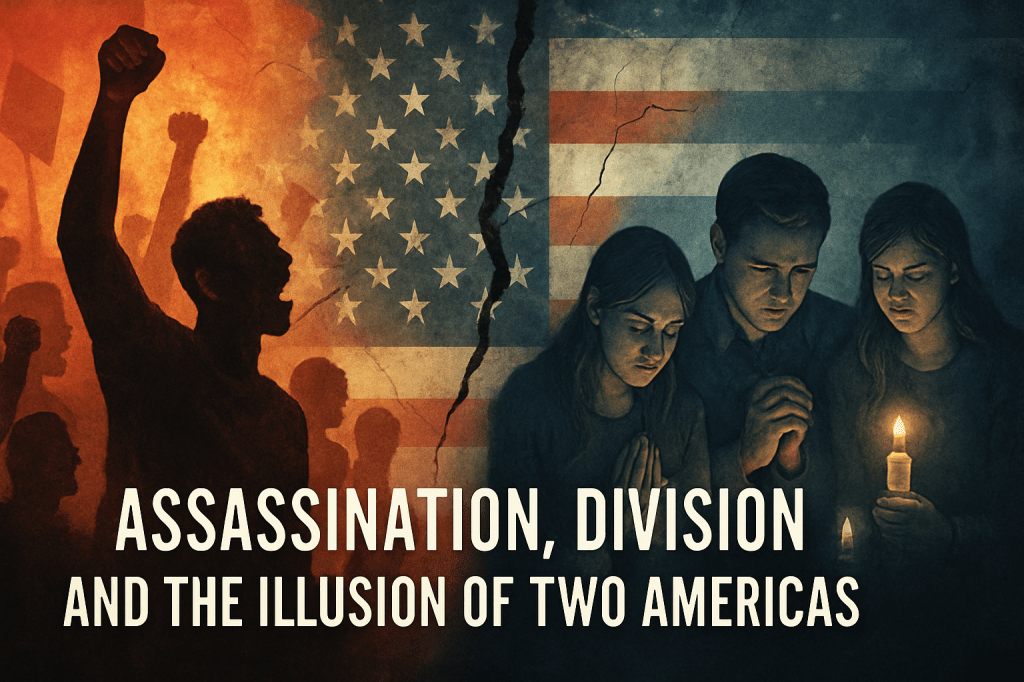
And I have seen both sides of that spell these past weeks. I have seen people cheer a murder like it was a sporting event. And I have seen strangers kneel in prayer for a family they never met. I have watched online mobs mock and jeer, and I have seen quiet circles of light form in vigils. That light may be quieter, but it is stronger. The Christian message Kirk carried–that truth endures, that the Church grows under persecution, that light cannot be overcome–has already begun to prove itself in the aftermath. His voice has been silenced, but his message is echoing louder than ever.
Violence does not end lies. Murder does not end hate. Martin Luther King Jr. said it best: “Darkness cannot drive out darkness; only light can do that. Hate cannot drive out hate; only love can do that.” The divide before us is not left versus right. It is light versus darkness. And each of us, in how we respond, reveals which side we are strengthening. Charlie himself often pointed to Scripture. One of his favorite verses was Ephesians 5:25: “Husbands, love your wives, just as Christ loved the church and gave himself up for her.” That picture of sacrificial love stands in absolute contrast to the violence we are witnessing now. It is a reminder that real strength is not found in domination, rage, or vengeance, but in choosing to give of yourself for the sake of others. That is the kind of love that darkness cannot overcome.
References
Biden, Joe. (2016). Campaign remarks: “If we were in high school, I’d take him behind the
gym and beat the hell out of him.” (The Guardian, Oct 2016).
De Niro, Robert. (2016). Campaign video: “I’d like to punch him in the face.” (CBS News,
Oct 2016).
Depp, Johnny. (2017). Glastonbury Festival: “When was the last time an actor assassinated a
president?” (BBC News, June 2017).
Madonna. (2017). Women’s March speech: “Yes, I have thought an awful lot about blowing
up the White House.” (CNN, Jan 2017).
Luigi Mangione case: City Journal (Aug 3, 2025); Saratoga Falcon (Feb 15, 2025).
Martin Luther King Jr. (1967). Where Do We Go From Here: Chaos or Community? “Darkness
cannot drive out darkness; only light can do that. Hate cannot drive out hate; only love
can do that.”
Historical assassinations: JFK (1963), MLK (1968), Yitzhak Rabin (1995).
Erika Kirk on Charlie’s favorite verse, Ephesians 5:25. (Facebook, 2016).
 Unfiltered with Jessica
Leave a comment