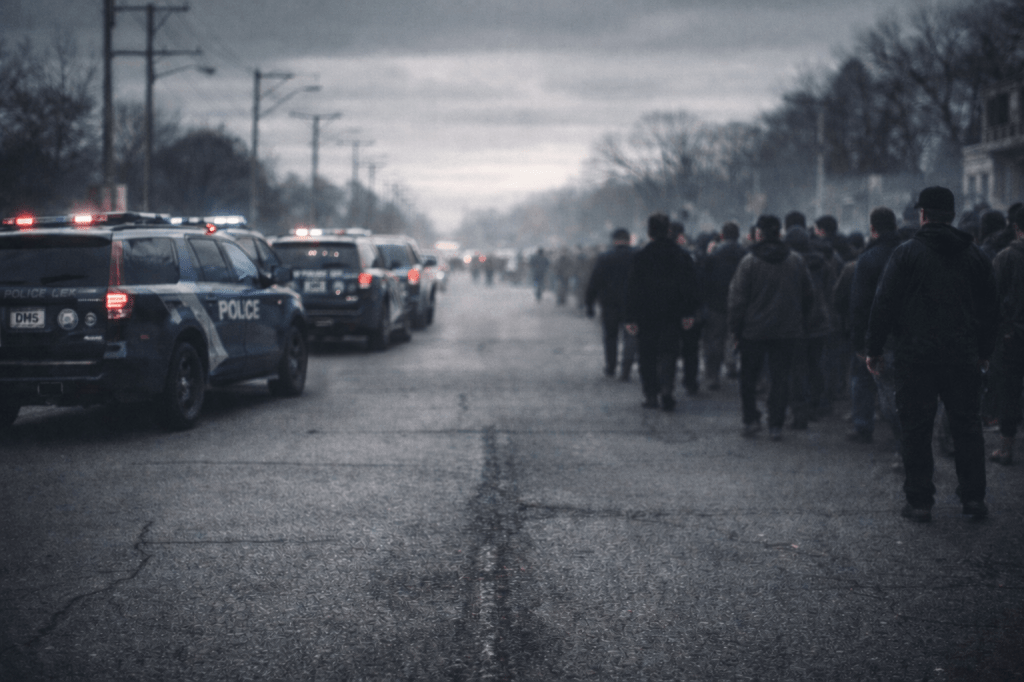
I’m going to be honest—being online right now makes me feel kind of sick. Every time I open my phone, it’s another video, another headline, another tragedy, and another person screaming that this is the moment that proves their side is right and the other side is evil. ICE. Minneapolis. Protests. Deaths. Kids. It never stops, and what’s disturbing isn’t just the volume, but the way real human lives are being consumed and repurposed almost instantly as arguments. It doesn’t feel like we’re processing events anymore; it feels like we’re consuming fragments of horror and immediately turning them into proof points. Every death becomes a weapon, every tragedy a chess piece, every life sorted into who gets amplified, who gets ignored, which deaths become hashtags and which quietly disappear. And if you don’t react fast enough—if you hesitate, ask questions, or say, “This is tragic, but complicated,” you’re treated like you’re cold, stupid, or morally defective. There’s no space to think, no space to grieve without immediately being drafted into a side, and no tolerance for the idea that something about this entire dynamic feels deeply unhealthy. That’s the part that gets to me most.
Part of why this feels so overwhelming is because, at a very basic psychological level, we were never built for this. Human beings are not designed to emotionally carry the weight of endless global tragedy in real time. Anthropologist Robin Dunbar proposed that humans can meaningfully maintain around 150 stable relationships—a rough measure of our emotional bandwidth. Yet the internet demands that we emotionally engage with thousands of strangers, victims, perpetrators, and crises simultaneously, and not just engage with them privately, but respond instantly, publicly, and with the “correct” moral posture. Add to that the identifiable victim effect, which shows that people respond far more strongly to one named individual than to large numbers of victims, and you get a system that constantly hijacks attention and judgment by isolating emotionally charged stories and ripping them out of context. When empathy is pushed past its natural limits, it doesn’t expand—it collapses. People don’t become more thoughtful under that pressure; they become more extreme. Grief turns into outrage, outrage turns into identity, and identity starts demanding loyalty even when the facts are incomplete or uncomfortable. Emotion becomes evidence. Intensity becomes truth. And once emotional intensity becomes the standard for moral correctness, nuance isn’t just discouraged—it’s treated as betrayal.
This is exactly why the conversation around ICE collapses so quickly. People argue endlessly about policy, slogans, and optics while skipping over the actual cases that are shaping how people feel. But when you slow down and look at those cases honestly, what you find isn’t moral clarity—it’s complexity. In Minnesota, two U.S. citizens were detained by federal immigration agents despite providing proof of citizenship. There was no judicial warrant. They were injured during the detention and later dropped miles away at a Walmart, shaken, bleeding, and confused. That should alarm everyone, regardless of political party. If federal agents can ignore proof of citizenship, bypass warrants, and relocate people without due process, that is not border enforcement—that is state power being abused. When enforcement shifts from probable cause to appearance or proximity, that is racial profiling, and agents who behave that way should be held accountable.
Then there’s Renée Good, who was shot and killed inside her vehicle during a chaotic confrontation with federal agents. Was driving forward in a tense situation involving armed officers smart? No. Was it dangerous? Yes. But fear does not make people rational, panic does not make people strategic, and a bad decision made under terror does not justify a death sentence. The same grey exists in the case of Alex Pretti, who was legally carrying a firearm at a protest and was later killed during a volatile encounter with federal agents. Many on the right rushed to say it was dumb to bring a gun to a protest—a strange position for a movement built on the idea that rights don’t disappear when circumstances get uncomfortable. You can call his actions reckless and still say that lethal force should never be the default response to chaos. And then there’s the five-year-old boy whose detention consumed the internet—a child abandoned when his father ran, caught between state authority, adult fear, and competing narratives, and immediately turned into a political symbol. That alone should stop us from pretending this is simple. At the same time, and this is where honesty actually matters—there are hundreds of documented cases every year of illegal aliens committing violent crimes against civilians, many of them against women and children. People remember Laken Riley, a 22-year-old nursing student murdered while out for a run. They remember Rachel Morin, a mother of five murdered on a hiking trail. They remember Jocelyn Nungaray, a 12-year-old girl raped and murdered in Houston. They remember the Georgia case where an 11-year-old girl was raped at knifepoint while her 10-year-old sister was forced to watch. These are not hypotheticals or internet exaggerations—they are police reports, prosecutions, and families whose lives were permanently destroyed. When you are a parent, these stories don’t feel political; they feel personal. This is the lens many people on the right are viewing this through—not spreadsheets or slogans, but fear, responsibility, and the instinct to protect their children.
And here is the comparison that quietly drives so much of this debate, whether people admit it or not. On one side, there are hundreds of violent crimes against civilians committed by illegal aliens every year—crimes that are brutal, personal, and often involve women and children. On the other side, there were 32 people who died in ICE custody last year, alongside a small number of tragic enforcement-related shootings. Every one of those deaths matters, and every one of them deserves scrutiny, accountability, and investigation. But for many people on the right—a political group made up disproportionately of parents, families, and people raising children—that comparison hits at a very primal level. When your primary responsibility is protecting your kids, your tolerance for risk changes. Your moral calculus shifts. And many of those people look at civilians being raped, murdered, or permanently harmed by people who skipped due process to be here, and conclude—often painfully—that stricter enforcement feels like a necessary pain they wish they didn’t have to accept, but believe they can’t afford to ignore. Not because they’re cruel. Not because they enjoy suffering. But because protecting their children feels non-negotiable.
The real danger right now isn’t disagreement; it’s division so deep that we stop seeing each other as human. We are being shown the most extreme versions of each side on purpose. Algorithms don’t amplify normal people who want safety and dignity, they amplify outrage because outrage keeps us engaged, polarized, and easier to manipulate. Most people are not extremists. Most people didn’t vote for chaos. Most people want borders and accountability, safety and restraint, order and humanity at the same time—even if that rational middle rarely goes viral. We have far more in common with our neighbors than with the institutions and media machines that profit from constant conflict, and the moment we stop treating each other as enemies, the entire game changes. You don’t have to celebrate death to support law and order. You don’t have to deny fear to care about compassion. And you don’t have to abandon nuance to stand for something meaningful.
Humanity doesn’t live in slogans—it lives in the grey.
And if we lose that, no side actually wins.
 Unfiltered with Jessica
Leave a comment