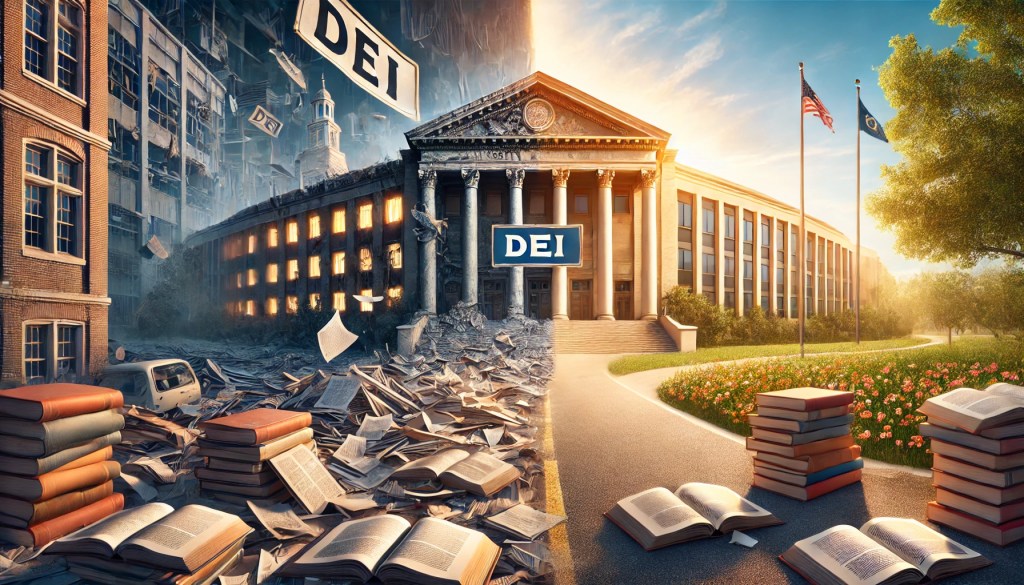
As I near the end of my time in college, I can’t help but feel a strange mix of validation and conflict. For years, Diversity, Equity, and Inclusion (DEI) initiatives seemed inescapable, woven into nearly every aspect of higher education. From mandatory courses to administrative policies, DEI became a framework that governed how we thought, learned, and engaged. But for many students, including myself, these programs often felt more like ideological mandates than meaningful education. Now, as I prepare to graduate in Arizona, DEI policies are being dismantled across the country. On one hand, it feels validating to see skepticism about these initiatives gaining traction. On the other hand, I’m left questioning whether the countless hours I spent engaging with DEI material were ultimately for nothing.
My personal experiences with DEI began in the classroom. I was required to take courses centered on these principles, often feeling they were less about practical skills or intellectual growth and more about fulfilling institutional obligations. Even my professor—someone tasked with teaching a DEI course—hinted at opposing feelings about the material, though they admitted their hands were tied. It was clear that, for educators as well as students, these initiatives were often more about compliance than conviction. Now, as the political landscape shifts and DEI programs are being eliminated, it feels like the framework that dominated so much of my college experience is evaporating overnight.
The catalyst for this change has been a series of executive orders issued by President Donald Trump in January 2025. These directives eliminated DEI programs within federal agencies and contractors, framing them as wasteful and discriminatory. The administration argued that such initiatives deviated from meritocratic principles and fostered identity-based favoritism (The White House, 2025a, 2025b). While these orders specifically target federal operations, the ripple effects on higher education are impossible to ignore, especially for public universities that depend on federal funding.
In states like Florida and Texas, universities have already begun dismantling DEI offices and cutting related programs. The University of North Carolina, for example, recently redirected millions of dollars away from DEI efforts, signaling a cultural shift in how universities approach diversity (Goldwater Institute, 2024). The Supreme Court’s 2023 ruling to end race-based affirmative action in college admissions has further reinforced this movement, requiring universities to find new ways to foster diversity without violating legal restrictions (Sidley, 2023).
For students like me, this moment raises complicated emotions. On one level, I can’t help but feel validated. The skepticism I carried through my DEI courses—questions about their purpose, value, and real-world relevance—seems to have been shared by others. On another level, there’s frustration. What was the point of these mandatory courses if the very framework supporting them is being dismantled? Were these classes simply a reflection of political trends that are now being reversed, leaving students like me to wonder whether our time, money, and energy were well spent?
Beyond the classroom, these changes force us to confront broader questions about the future of higher education. Will universities eliminate DEI programs entirely, or will they adapt them to align with the current political climate? And what about admissions? The Supreme Court’s decision already mandates a shift away from race-based considerations, but will institutions embrace purely merit-based criteria, or will they implement new methods to quietly uphold diversity quotas? For years, DEI seemed omnipresent in university policies, but now, with the rug being pulled out from under it, the future remains uncertain.
As these shifts unfold, I find myself reflecting on what it means to be a student caught in the middle of this ideological tug-of-war. For years, I felt like a pawn in a broader cultural and political battle, expected to engage with DEI principles without much choice or agency. Now, as these policies are being reevaluated, I’m curious about how universities will navigate this transition. Some institutions are already scaling back DEI efforts in anticipation of federal mandates (The Guardian, 2024), while others remain committed to fostering diversity, even as they face increasing scrutiny. The next few years will reveal whether universities can strike a balance between merit-based principles and the values of inclusivity.
What remains clear is that we are witnessing a profound transformation in higher education. As DEI initiatives are phased out or reimagined, universities have an opportunity to refocus on their core mission: equipping students with the skills and knowledge they need to thrive in the real world. For those of us graduating during this period of upheaval, this moment feels like both an ending and a beginning. The framework that defined so much of our academic experience is being dismantled, but what replaces it may ultimately define the next generation of higher education. Only time will tell how this narrative unfolds, but for now, I’ll be watching closely, curious to see where it leads.
References
The White House. (2025a). Ending radical and wasteful government DEI programs and preferencing. Retrieved from https://www.whitehouse.gov
The White House. (2025b). Ending illegal discrimination and restoring merit-based opportunity. Retrieved from https://www.whitehouse.gov
Goldwater Institute. (2024). Three more states drop DEI programs at their public universities. Retrieved from https://www.goldwaterinstitute.org
Sidley. (2023). U.S. Supreme Court ends affirmative action in higher education: An overview and practical next steps. Retrieved from https://www.sidley.com
The Guardian. (2024). Trump promises a crackdown on diversity initiatives. Fearful institutions are dialing them back already. Retrieved from https://www.theguardian.com


 Unfiltered with Jessica
Leave a reply to PRossi Cancel reply