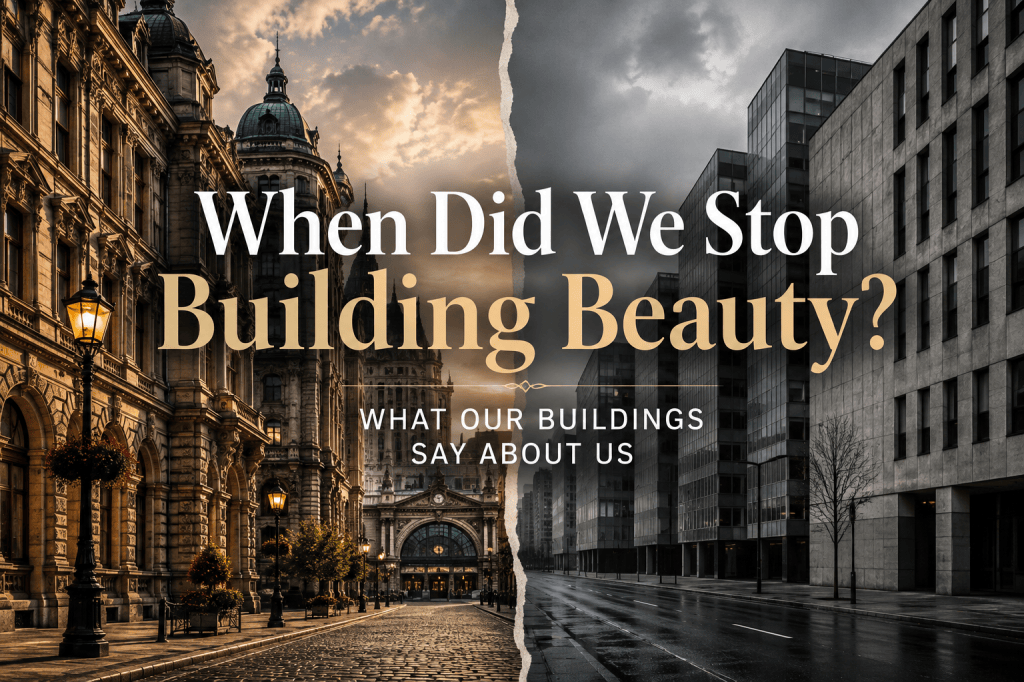
Have You Ever Noticed How Many Things Used to Feel… Intentional?
I don’t mean life was better. Every generation likes to romanticize the past, and I have no interest in pretending the 1800s were some golden age. They weren’t. People worked harder, died younger, and dealt with problems we’d never willingly trade places with.
But there’s one thing I can’t stop noticing. Somewhere along the way, we stopped making things people actually wanted to look at.
Not just buildings.
Everything.
The ceilings got lower. The windows got smaller. Brass became plastic. Solid wood became particle board. Libraries stopped feeling like places that inspired learning and started feeling like offices that happened to have books. Schools became long hallways under fluorescent lights. Hospitals became places you couldn’t wait to leave. Even something as ordinary as a doorknob used to have weight in your hand, while today it feels like it was designed with one goal in mind: surviving just long enough to make it past the warranty.
None of those changes seem particularly important on their own. Together, though, they made me wonder if we’d quietly accepted an idea previous generations never would have. That beauty is optional. What’s strange is that this doesn’t seem to reflect what people actually want.
Every year millions of tourists cross oceans to wander through the oldest parts of cities. In America, they flock to Charleston, Savannah, Boston, New Orleans, and the historic downtowns that somehow escaped redevelopment. Even in our own hometowns, the buildings people fight hardest to preserve are almost always the oldest ones. Nobody starts a petition to save the strip mall built in 1998.
If we instinctively love these places, why don’t we build them anymore?
I thought I was going to spend a few hours reading about architecture. Instead, I found myself reading about city planning, psychology, history, and economics, realizing this wasn’t really a story about buildings. It was a story about what happens when a civilization quietly changes what it values.
One of the biggest turning points I kept coming back to was urban renewal, the massive redevelopment movement that reshaped American cities after World War II. Beginning with the Housing Act of 1949, the federal government funded cities to clear neighborhoods labeled as “blighted” and rebuild them according to modern planning principles. Local governments, planners like Robert Moses, architects, engineers, and private developers all played a role in reshaping the American landscape.
At first glance, the reasoning wasn’t difficult to understand. America was changing rapidly. Cities were expanding, automobiles were replacing streetcars, and aging infrastructure demanded attention. Modernism promised cleaner cities, wider roads, and a future built for an industrial age. To many planners, replacing the old with the new didn’t just seem reasonable—it seemed responsible.
However, Cities aren’t experienced from an aerial map. They’re experienced from the sidewalk.
A planner might see deteriorating buildings and inefficient traffic patterns. A family sees the church where generations were married, the neighborhood bakery where everyone knows each other’s names, the library where they first fell in love with reading, and streets stitched together by decades of ordinary moments that slowly become a life. Those are things a blueprint can’t measure, and once they’re gone, they’re remarkably difficult to rebuild.
At the same time, architecture itself was undergoing a philosophical revolution. Modernist architects increasingly rejected ornament and historical styles in favor of efficiency, standardization, and the machine age. Thinkers like Le Corbusier, Adolf Loos, and the Bauhaus movement believed buildings should reflect the modern world rather than imitate the past. Whether those ideas represented genuine progress, economic convenience, ideological certainty, or something more intentional is a question I don’t think should be dismissed too quickly.
What isn’t really debated is the outcome.
Entire neighborhoods disappeared beneath highways. Historic downtowns were fractured. Public buildings that once reflected permanence, craftsmanship, and civic pride gave way to structures designed primarily for efficiency, speed, and cost. Perhaps no example captures that shift more clearly than the demolition of New York’s original Pennsylvania Station in 1963. One of America’s greatest architectural achievements wasn’t replaced with something equally inspiring. It was replaced with something that simply worked. Somewhere in the middle of all that reading, I found myself asking a different question.
What if beauty hadn’t simply been disappearing from the world around us?
What if it had been quietly shaping us all along?
For most of history, civilizations built places meant to inspire as much as they functioned. Libraries reflected the value of learning. Courthouses reflected the dignity of justice. Even train stations were designed to leave visitors with a lasting impression of the city they had just entered.
If you’re reading this you might be thinking, “Okay… but aren’t we just talking about aesthetics?”
After all, beauty feels subjective. One person loves Victorian homes. Another prefers sleek modern architecture. Surely this all comes down to personal taste. The deeper I dug, though, the less convincing that explanation became.
Psychologists, neuroscientists, architects, and environmental researchers have spent decades studying our relationship with the built environment, and while they don’t all agree on what makes something beautiful, they do agree on something far more interesting:
The environments we spend our lives in quietly shape the way we think, feel, and even who we become.
Why do old libraries make you want to sit down and read? Why do cathedrals instinctively make people lower their voices? Why does walking into an old courthouse feel different than walking into a modern office building, even though both exist to serve the public?
It turns out our brains are constantly reading the spaces around us, whether we’re paying attention or not.
Researchers have found that higher ceilings encourage more abstract and creative thinking, while lower ceilings promote narrower, detail-oriented thinking. Studies on natural light and green space consistently show improvements in mood, stress, attention, and even physical recovery. One of the most famous hospital studies found that patients whose windows overlooked trees recovered faster and required less pain medication than those staring at a brick wall. Our surroundings are not psychologically neutral.
Maybe beauty isn’t simply decoration.
Maybe it’s one of the ways a civilization communicates what it values.
A soaring ceiling doesn’t magically make someone more creative, but it subtly encourages openness and possibility. A magnificent library tells a child that learning matters before they’ve opened a single book. A courthouse built with dignity quietly communicates that justice matters. Architecture doesn’t force those ideas into our minds, but it creates an environment where they feel natural.
That made me wonder about the subtle messages we’re surrounded by today. Lower ceilings. Fluorescent lighting. Blank drywall. Plastic fixtures. Materials chosen almost entirely because they’re inexpensive, easy to replace, and require very little craftsmanship. None of those decisions are catastrophic on their own, but taken together they communicate something very different. They suggest efficiency matters more than experience, and that “good enough” really is good enough.
So what happens to a generation that grows up almost entirely surrounded by places that were never designed to inspire them? Because inspiration itself was no longer considered part of the job.
One architect who spent decades wrestling with that question was Christopher Alexander. Rather than asking which architectural style people preferred, he asked why certain places simply felt alive. After studying towns and public spaces around the world, he found that the places people consistently loved shared remarkable similarities: they felt human in scale, encouraged interaction, used natural materials, and invited people to linger. Whether you agree with all of his conclusions isn’t really the point. What fascinates me is how often modern psychology has arrived at many of the same observations through entirely different paths.
The more I sat with all of this, the harder it became to dismiss beauty as something superficial. Maybe the civilizations we admire weren’t simply decorating the world around them. Maybe they understood that the environments people inhabit eventually become part of the people they become.
That realization made another contradiction impossible to ignore. Historic neighborhoods consistently become some of the most desirable places to live. Cities spend millions restoring century-old theaters, libraries, and train stations, while homeowners willingly pay premiums for craftsmanship, character, and tree-lined streets. If beauty had so little value, why are we constantly willing to pay more for it?
Perhaps that’s because economics doesn’t just reveal what something costs.
It reveals what people value.
I started wondering whether beauty was simply what emerged when a civilization genuinely believed something else first—that education mattered enough to deserve inspiring schools, justice mattered enough to deserve dignified public buildings, and ordinary people deserved neighborhoods built with care rather than mere convenience.
If the research is even partially correct, then the places we create are never merely backdrops to our lives. They quietly shape our expectations, our habits, and our understanding of what is normal. We shape our surroundings first, but over time our surroundings begin shaping us in return, which means every decision about the built environment is also, in some small way, a decision about the culture we’re handing to the next generation.
Architecture simply happened to be the doorway into a much larger question. Every generation leaves behind evidence of what it believed—not only in the books it wrote or the technology it invented, but in the ordinary places where everyday life unfolded. Those places quietly reveal what a society believed people deserved long after speeches have been forgotten and political debates have faded.
This isn’t an argument against progress. It’s an argument for remembering that efficiency isn’t the only thing worth optimizing. Because if future generations someday judge us by the places we built—as we so often judge the civilizations that came before us—I can’t help but wonder what our buildings will quietly say about what we believed people deserved.


Leave a comment